
via Instagram http://ift.tt/2cuok7j


With iOS 10 I was upgrading security to two factor authentication – which comes at a price: convenience. But in essence its the best 2-factor thing I’ve seen so far, what Apple has built. As soon as ayou sign in on an apple device, the iPhone pops up with the question to allow the sign in from a certain location (shows even a map, based on IP adress) and a 6 figure code.
Problem was: the AppleTV didn’t come with an interface to put the code in. So the solution is: put the 6 figure code behind your password like:
password123456
„password“ is your standard icloud password. Should be working on toher systems as well.
Update:
If you are on any other (non Apple) device, where you are connected via icloud, you need to set a specific password for that application. I need that e.g. for Windows 10 calendar app and after I got my Microsoft Outlook for cheap too. For that, naviagte to: https://appleid.apple.com
Security > Edit > App-sepcific passwords > create password. You can then use that specific password for your needs.

We just moved from another mail provider to strato, with one of our companies.
As we are running several online shops based on shopware with this company, we also had so re-setup the mailing stuff, and I just wanted to document that here – none the less for my self documentation. We are running on an AWS Ubuntu 14.04.5 LTS environment
These are the settings within Shopware 5 for Strato Mailservers:
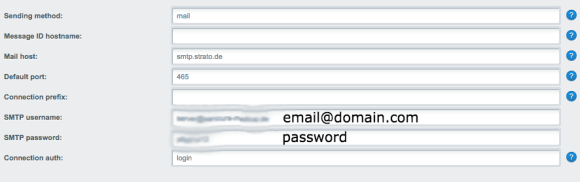
In the first place I was not able to send emails (in shopware 5 you can send testmails by clicking „send testmail to shop owner“ at Configuration -> Email Templates -> System emails -> sOrder -> Send test mail to shop owner)

I did a „tail -f /var/log/mail“ on the server, so examine why we were not able to send via sendmail to the smtp, and all I got was a lousy: DSN Service unavailable.
Sep 2 18:19:26 (none) sendmail[17696]: u82IJQ4j017696: from=www-data, size=1467, class=0, nrcpts=1, msgid=<201609021819.u82IJQ4j017696@(none)>, relay=www-data@localhost
Sep 2 18:19:26 (none) sm-mta[17697]: u82IJQBv017697: localhost [127.0.0.1] did not issue MAIL/EXPN/VRFY/ETRN during connection to MTA-v4
Sep 2 18:19:26 (none) sendmail[17696]: u82IJQ4j017696: to=bestellung@theshopname.com, ctladdr=www-data (33/33), delay=00:00:00, xdelay=00:00:00, mailer=relay, pri=31467, relay=[127.0.0.1] [127.0.0.1], dsn=5.0.0, stat=Service unavailable
Sep 2 18:19:26 (none) sendmail[17696]: u82IJQ4j017696: u82IJQ4k017696: DSN: Service unavailable
So I did two things and they fixed my problem.
Voila – sending mail works flawlessly.

…im Nachhinein kann ich es wirklich nicht mehr sagen, geschweige denn nachvollziehen, aber: von heute auf morgen war mein webserver, der das Blog hier betreibt, nicht mehr in der AWS mgmt. Console zu finden. Nicht nur das: der war grundsätzlich einfach GAR nicht mehr da. Sogar die Elastic-IP war auf einmal wieder released, so dass klar war: das Ding ist so _richtig_ weg. Naja, wahrscheinlich hat irgendwer bei Amazon nen Kabel falsch gesteckt… ach stimmt: das ist ja alles virtuelles Zeugs.
Meine Backup Strategie (cron db-dumps, directory-tar’s auf allen Severn, dann rsync in den Bunker) habe ich wohl irgendwie bei meiner privaten Maschine vergessen.
Schön aber, dass es bei AWS EC2 die EBS gibt. Das sind sozusagen virtuelle Volumes, die an eine Maschine „attached“ werden. Dumm nur, dass ich dabei so um die 100 Stck. in meinem Account habe, teilweise attached, teilweise unattached.
Man kann die aber an laufende Maschinen anlegen, und dann darauf zugreifen.

Über ein mount /dev/xvdg /media/platte kann man dann die Platte mounten (Achtung: ältere Kernel machen aus einem /dev/sdg ein /dev/xvdg).
Und siehe da: ich habe das richtige Volume gefunden.
Dann kann man aus einem Volume einen Snapshot erstellen. (Rechte Mausttase -> create Snapshot).
Danach aus einem Snapshot ein „image“ – dies ist dann unter „Images -> AMIs“ zu finden. Achtung: dabei kann man auswählen, um was für ein Image es sich handeln soll. Hier ist es wichtig zu wissen, um welche Architektur es sich bei dem alten Sytem handelt, und welcher Kernel benutzt wurde – sonst kann es sein, das die Maschine einfach nicht mehr startet.

Danach „launcht“ man die AMI einfach nur noch (hier kann man die Serverkonfig vornehmen, Memory, CPU etc.) und braucht dann hoffentlich nur noch die Elastische IP wieder auf die neue, laufende Maschine zu mappen.
Good Luck!


So, heute also die 3. Woche Windows 10 (und ohne OSX) und es gibt doch ein paar Dinge, die ich festhalten will:
Was immer noch Mist ist, sind Screenshots. Dieses Snipping Tool ist auch so Win XP und die ganzen 3rd Party tools sind irgendwie nicht nice integriert. Wenn da jemand was kennt…

At my-vpa we are running an integrated groupware environment to ensure a consistant, stable and secure workdesk based on Open-Xchange for our employees.
Additionally we use strato as our primary mail-service in the open wild and have the OX connected to it. So far so good. The only problem is, strato doesn’t support the sieve protocol for external services, so we are not able to use mailfilters (think: autoresponder when you are on holiday).
So, my idea is, to set up an own mailserver, which fetches from strato through imap, serves imap locally via dovecot and uses dovecot-sieve, to enable sieve rules in OX. It could look like this:

I am going to write an update as soon as I’ve figured out, how that all sticks together, especially how I am going to handle the synchronisation and user setup (think: we have 100+ employees)

With our company mein-virtuellerassistent.com we were using a website we have built 6 years ago. Being the german market leader in the virtual private assistant soace, tomorrow is the german relaunch and rebranding to my-vpa.com. Besides many technical improvements under the hood (we`ve built a super sophisticated task management tool – I haven´t heard of something else coming near that, making it super easy to delegate tasks to outsourced resources) we are doing a website relaunch.
I´ve just been doing some performance tunings for the EC2 machine, the site is running on, and now found loader.io to do some performance-testing. For the moment (and the expected traffic) this looks somehow ok.

To the WordPress Amazon EC2 tuning part:
<IfModule prefork.c>
 StartServers       10
 MinSpareServers    10
 MaxSpareServers   10
 MaxClients       10
 MaxRequestsPerChild  4000
</IfModule
So, keeping fingers crossed, the 301s from the old site will keep on carry valuable organic traffic to our site…

Seit heute gibt es Pokemon Go ja auch in Deutschland und im Büro war niemand mehr in der Lage den Kopf zu heben, geschweige denn, ansprechbar zu sein. Alle Welt strömte nach dem Mittagessen nach draußen („Verdauungsspaziergang“) oder hetzte durch die Gänge („Er läuft weg..!!!“). Mit Wachstumsraten doppelt so hoch wie Tinder, mit einer Useractivity jenseits von Gut und Snapchat scheint Pokemon Go da anzuknüpfen, wo Pappkärtchen vor 20 Jahren aufgehört haben – nur dass jetzt erwachsene Menschen auf dem Firmen-Parkplatz und nicht mehr auf dem Schulhof stehen. Dass es dabei aber auch findige Köpfe gibt, die daraus sofort eine schneidige local business Strategie machen (Man kann dafür zahlen, dass besonders viele Pokemons auftauchen, die man fangen kann) finde ich hingegen bemerkenswert – einige Pizzerien sollen sich vor Pokemon suchenden Gästen kaum noch retten können, würden nicht Luigi und Co Sonderschichten fahren (ach nee, das war was anderes… 🙂 ) Mehr zu den, wie ich finde wirklich nicht schlechten Werbeideen für kleine Geschäfte auf Pokemon Go, bei den Kollegen von inc.com
(Beitragsbild von Miramax Films/Photofest)